Sunday, October 23, 2011

Day 133: a fish story

Happy birthday, Uncle Steve!

We spent a wonderful day with dear friends in Lexington, NC, who used to live in Colorado Springs. Chris and Lisa have two girls similar in ages to ours, and we all picked up right where we left off a few years ago. A morning at their church--a Moravian congregation--was followed by an afternoon of fishing at their neighborhood pond. Both Kelsey and Kendall caught fish...now they're hooked!

We reluctantly left after dinner for Asheville, our stop for the next four days.


Saturday, October 22, 2011

Day 132: Drivers, Start Your Engines

Stan's big day finally arrived...and it was, in his words, definitely worth the wait. He drove eight laps at the Charlotte Motor Speedway in #18, sponsored by M&Ms. Prior to the car's retirement from the active fleet, it was used by Kyle Bush and a few other luminaries of the NASCAR circuit.

The official NASCAR Experience certificate states that Stan reached 135.11 miles per hour...near the limit of 140 that's imposed by computer chips imbedded in the engine.  The adrenaline took a while to work out of his system; his hands were jittery for at least a half an hour after the drive ended...much longer than the eight minutes he was actually on the track. He said that 65 mph on the highway (half the speed of his racecar run) feels more comfortable, but that he'll never forget the experience of 135. That's a great comfort, given our limited insurance budget.


Stan (rt) and Brian, posing by a photo-opp car

One last hug from Kelsey

Thumbs up--it's a go!

Heading out of pit row


The winner!

Stan's coach, Smith, talked to Stan throughout the drive (via earbuds) and monitored his entire run from the roof of pit-row central

Our Raleigh friends, the VanVoorens. Stan and Brian added to the family lore...NASCAR memories!

Friday, October 21, 2011

Day 131: "Sweet Caroline"

Goodbye, South Carolina.  We’ve loved our time with you!
We squeezed in one more of its sites on our drive to North Carolina…Congaree National Park. It’s one of the last remaining stands—in the world!--of old-growth riverbottom forest.  Some of its trees are 700 years old and reach 16 stories into the sky.  Wildlife is abundant, although an alligator still eludes our check-off list. And incredibly, the swampy terrain was not the mosquito zone we’d anticipated. The visitor center’s official “Mosquito-meter” registered a “2--mild” on the scale that reaches “6--war zone."
We wrapped up our day with Raleigh friends, Amy and Brian, in the hallway of our hotel in Charlotte…it felt like the dorm days of college, hanging in the hall because roommates were sleeping. Brian and Stan head to the Speedway early in the morning for their training and preparation for the NASCAR Experience. The camera battery is charging in preparation for some fun photos! 


Thursday, October 20, 2011

Day 130: The funnier side of paradise

We made the most (or perhaps it's the least) of our final day on Hilton Head Island...pooltime (but only after a ton of schoolwork!) and then a visit to the adjacent wildlife refuge. The birds put on quite a show for us. But a funnier sight was had just a few yards from our door. An older man, sporting a walkman--the original, yellow cassette kind--attempted to sit in a hammock. In less time than it takes to blink, he was face down in the sand beneath it. A spry guy, he was back on his feet in no time for his second attempt...with the same results. Third time was the charm; he gingerly spread arms and legs so that he resembled a starfish, then slowly eased himself, inch by inch, onto the net surface, adjusting only to turn on his tunes. It was a scene worthy of YouTube; I would never post such a thing, though, because my own excounter with a hammock would likely be the same. :-)

Tomorrow we rendezvous with another of my college friends and her family...this time in Charlotte, N.C., so that Stan and her husband can cash in on our Christmas gifts to them: five laps around the Charlotte Motor Speedway, driving an authentic race vehicle. That'll happen Saturday morning; I've warned Stan he's not to plan on any practice sessions in the truck tomorrow.


Wednesday, October 19, 2011

Day 129: "Hey, Y'all!"

Paula Deen, chef of Food Network fame (and who liberally says tonight's title phrase), has helped to reinvigorate Savannah, Georgia, as a "foodie" destination. Today we ate lunch at "The Lady and Sons," the restaurant owned by Deen and her sons, enjoying the ultimate in Southern comfort dishes...fried chicken, creamed corn, mashed potatoes, collard greens, yams, green beans, and biscuits. Yum! Our arteries feel a little sluggish tonight, but our mouths enjoyed every bite. I have a feeling we consumed more butter (it was in every single dish) today than we have in six months of our usual healthier fare.

Savannah is a lovely city, one that contains neighborhood squares scattered throughout the historic downtown. In fact, 22 of the original 24 squares created when the city's grid was laid out by planners, in 1733, still exist. Many of them feature dramatic gardens and fountains, and some contain monuments and other historical markers. We lingered in Johnson Square, the city's first, which has at its center a tall obelisk dedicated to the memory of Revolutionary War hero Nathanael Greene, who died in Georgia (he was from Rhode Island). The square's fountains are surrounded by huge trees draped in Spanish moss and beds of greenery, which more than likely are full of blooming flowers in the spring and summer.

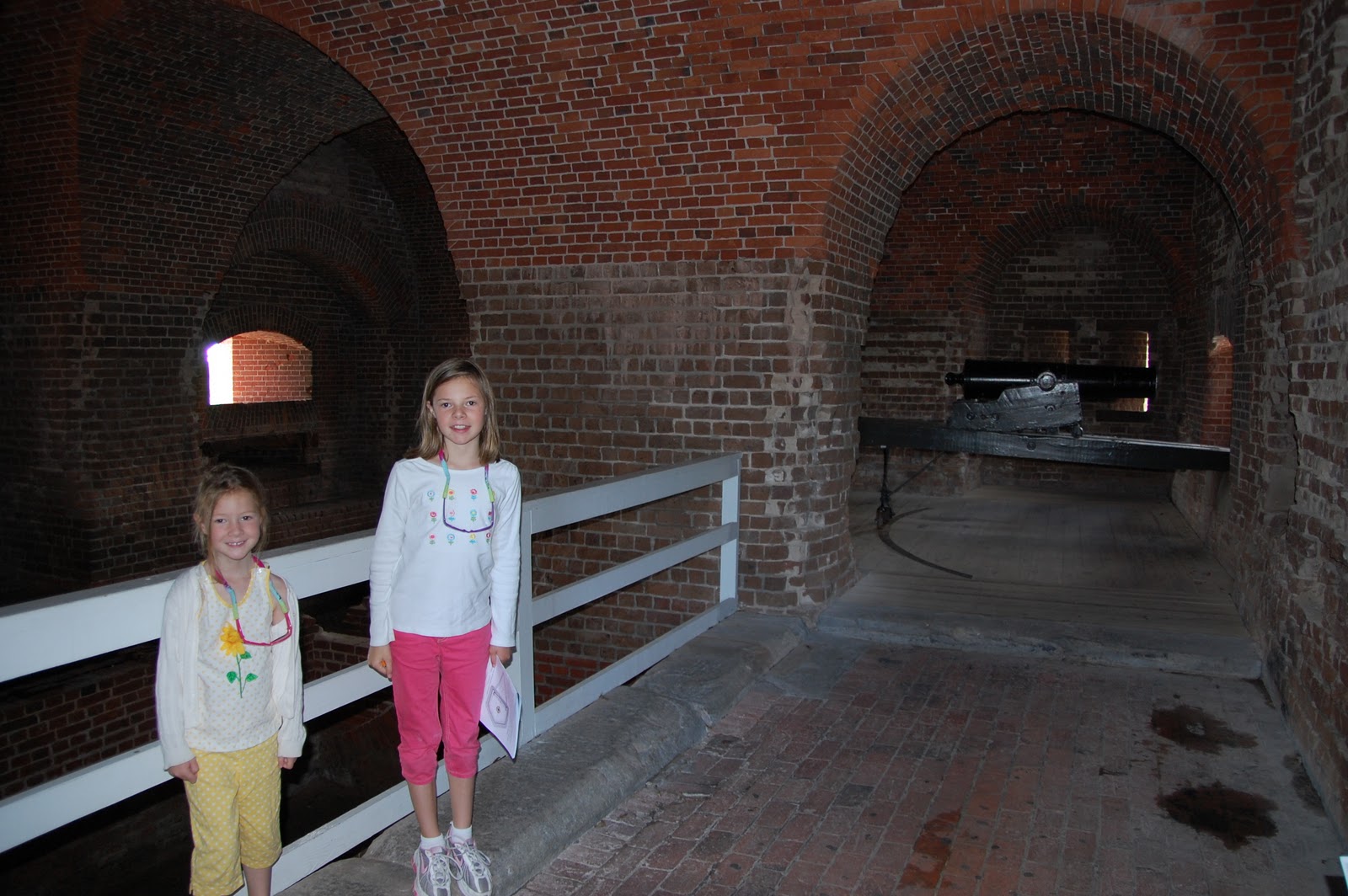
From Savannah's squares, we headed due east to Cockspur Island, home of Fort Pulaski National Monument. Upon its completion in the mid-1800s, it was considered one of the "most spectacular harbor defense structures" in the United States.  But its reputation was permanently blemished in April 1862, when it was the scene of a milestone battle during the Civil War. Union soldiers fired upon its occupants, Confederate soldiers, for 34 hours before the fort was surrendered. The historical significance is that rifled cannons--whose barrels were grooved or spiraled--were used for the first time, weapons that had much greater accuracy and impact. They ripped into the fort's brickwork, breaching its seven-foot-thick walls and compromising its structure.

The battle forced a permanent change in military strategy; no longer could stone or brick structures be considered defensive anchors for armies. If rifled guns could knock out huge sections of Fort Pulaski, so the reasoning went, not even the Rocky Mountains could withstand their destructive power.

Some of the damage was repaired by the new Union occupants, although there are still many obvious signs of the destruction, including gaping holes in the brickwork which contain unexploded shells. Another of the fort's defensive features is a moat, which is home to alligators (although we didn't see any!). Combined with iron-studded doors, drawbridges and cavernous, vaulted rooms, it was easy to imagine ourselves in a place of knights and dragons. To that end, it is a place of Hollywood drama; it was one of the major filming locations for the recent Robert Redford movie about the alleged plot behind Lincoln's assassination, "The Conspirator." Nice to know Fort Pulaski is finding new life past age 160.

A stuffed lady and daughters in front of The Lady and Sons

Our new best friend, Paula Deen


One of the entrances to Jackson Square

Entering Fort Pulaski


The terreplain, on the upper level of the fort's defenses.


Stan was disappointed to learn the casks were used for storing gunpowder, not wine.

The two holes above the window opening contain unexploded shells
The side facing inland is virtually unscathed...and quite dramatic rising out of the moat.


Tuesday, October 18, 2011

Day 128: For the record

Almost didn't post...but my pride is on the line...a ridiculous point of personal discipline. So, only for the sake of our own record, I'll state that our day was a perfect blend of work and play, sun and rain, talking and listening, and reflection and hopes. Tomorrow we'll once again "up" the pace, taking in a national park site or two. We're loving all that Hilton Head and the Low Country offer to us.

Monday, October 17, 2011

Day 127: A city that's seen it all

When the first shots of the Civil War were fired on Charleston's Fort Sumter, on April 12, 1861, the city was the pinnacle of southern elegance and sophistication. An important shipping port, it facilitated the South's cotton export and its import of the best of the world's goods. The city's oppulent mansions were built by plantation owners, whose slaves outnumbered their families by, in most cases, at least 5 to 1.

President Lincoln's election to the Presidency in November 1960 was gained without a single southern electoral vote. His victory was the spark that blew into full flame the very next month in South Carolina, the first state to secede from the Union. In reaction to that rebellious act, the 85 U.S. troops garrisoned at Fort Moultrie, on the northern side of the port, moved into the better fortified Fort Sumter on the night after Christmas. The troops' commander, Anderson, believed the island fort was more defensible...a brick pentagon three stories tall that hosted more than 60 cannon. But Southerns saw Anderson's move as predatory, and were outraged that their newly founded Confederacy was not respected and released by federal troops.

As tensions between North and South grew, the fort became the focal point. Confederates decided to reclaim it, and in the early morning hours of April 12, an initial bomb exploding above it was the signal to the Confederate-held forts all around the harbor to fire...and did they ever. Thirty-four hours later, more than 3,000 projectiles had been launched into the structure, collapsing the top two stories. And the small Union garrison couldn't man enough of the guns to launch an effective response. Anderson negotiated a surrender on April 13. Incredibly, not a single life had been lost, although two men died following a cannon misfire during the surrender ceremony.  Those two casualties were the first of the more than 620,000 lives lost over the course of the war...2% of the country's population.

Charleston has survived more than Civil War; a severe earthquake (believed a seven on the modern Richter scale) in 1886 damaged or destroyed nearly every single building. The brick structures that could be saved were bolted back together by screws that were drilled through from one side to the other. Hurricane Hugo, in 1989, brought further destruction. But the city is proudly resilient; it bears its scars with pride, although it does try to dress them up with pastel paint (Rainbow Row), gorgeous gardens and decorative hardware (often covering the bolts).

The city's skyline is nearly unchanged from 150 years ago, when its numerous church spires dominated. One of them sits above the oldest and only active independent Huegenot church in America. Founded in the 1600s by French Protestants who refused to conform to the Church of England, the congregation still celebrates some of its special services with French liturgy. The cultural influence of France also is evident in the city's French quarter...it looks similar to New Orleans, but I found it much more charming and classy. Stan and I had fun envisioning a future trip in which we stay in one of the many stately homes that have been turned into bed-and-breakfast inns.

Charleston's history has so much more to offer than what we could experience in one day. We want to return and take in its present--fantastic restaurants, galleries and museums--as well as revisit the significant places we saw today.

 Inside the fort...

...with a close-up of the cute tourists and the damaged walls

flag flown during the April 12 bombardment

on the jetty leading to the boat...the fort is accessible only by water


a sun-glare glimpse of some of the colorful homes on Rainbow Row